AirOps Research Agent System
19-agent, 13-skill multi-agent orchestration system running end-to-end research report production at AirOps. Plugin-style YAML-defined agents with per-agent skill loadouts, three lifecycle maps (full report, micro-report, insight drip), per-agent session memory, and cross-tool MCP integration across Notion, Slack, Asana, AirOps, ClickHouse, and Google Workspace.
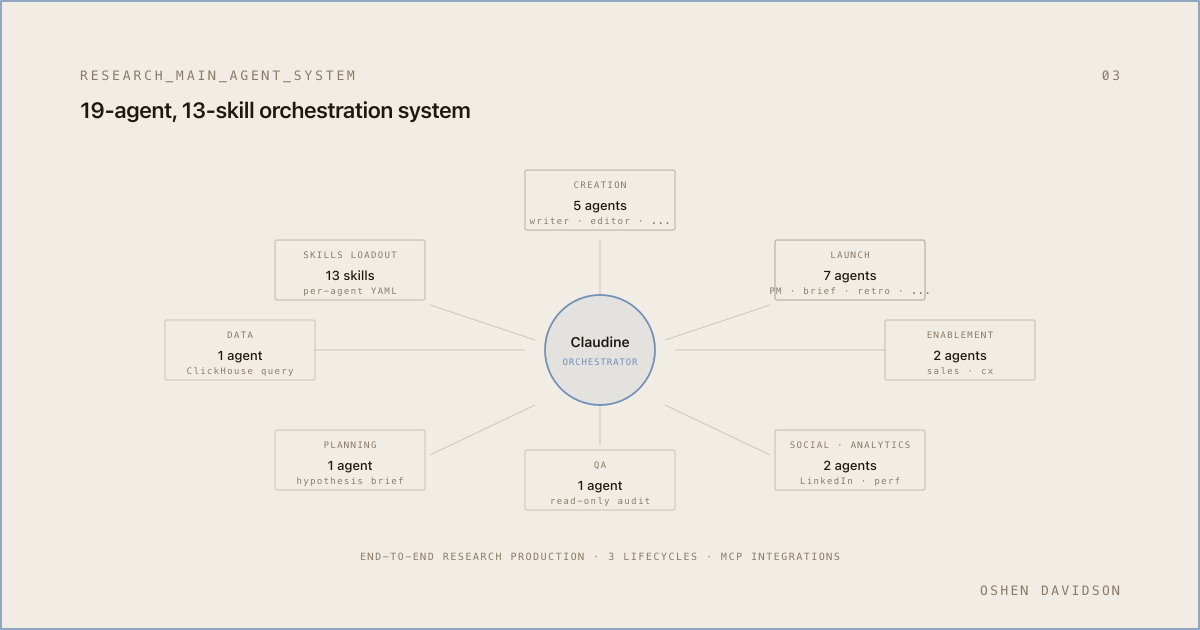
The AirOps Research Agent System is a multi-agent orchestration system that runs end-to-end research report production. It coordinates 19 specialized agents across 8 functional areas (planning, data, creation, launch, enablement, social, analytics, QA) through a chief-executioner orchestrator agent that decides whether to handle a task directly or delegate to a specialist.
The gap it closes
Running a research function solo means doing every step of every report end-to-end: idea generation, hypothesis design, data work, drafting, editing against voice and style standards, QA, asset design, launch coordination across multiple teams, email and Slack announcements, distribution, and post-launch performance tracking. Without an orchestration layer, throughput is bounded by the slowest manual handoff. Chat-only LLMs lose context across sessions. Off-the-shelf agent frameworks do not match how research work actually flows. A single “do everything” agent collapses under cross-cutting style, voice, and brand rules.
Architecture
Orchestrator and specialists
A chief-executioner orchestrator agent above 19 specialists. The orchestrator handles delegation decisions and shared-state tasks. Specialists each have their own minimum-viable tool surface and a dedicated skill loadout. Functional breakdown: planning (1 agent), data (1), creation (5), launch (7), enablement (2), social (1), analytics (1), QA (1).
Agent plugin architecture
Each agent is a YAML-frontmatter markdown file declaring its tools, loaded skills, and references. Adding a new agent does not require code changes to a runtime. Agent definitions are the source of truth, consumed at agent-spawn time.
Skill loadout system
13 skills as markdown directories with optional reference files, symlinked between repo source and the installed skills directory for edit-time hot-reload. Each agent declares which skills it loads in its YAML, so a writer agent always loads the writing skill plus the voice skill without those being hardcoded into the agent definition.
Lifecycle maps
Three lifecycle maps formalize the supported work patterns:
- Full report. Multi-week, multi-stage, full agent pipeline. Hypothesis brief through CEO approval, data analysis, drafting, editing, QA, asset design, launch coordination, enablement, distribution, performance tracking.
- Micro-report. Single focused finding, lighter pipeline, roughly 10 to 14 business days.
- Insight drip. Quick-turn social-ready insight generated from production data, 1 to 2 day turnaround.
Each lifecycle is a diagram showing which agents fire at which stage and where the handoffs are.
Per-agent session memory and feedback loop
Each agent has its own memory directory with two files: a working-memory file (temporary feedback queue surfaced at the start of each agent run) and a session-history file (permanent session log). Feedback captured in conversation gets promoted into the agent’s definition or a skill reference once a pattern is confirmed. The system hardens with each session rather than drifting.
Agents are instructed to proactively flag missing references, vague rules, manual workflow steps that should be encoded, and gaps in the YAML schema, so the orchestration system functions as its own continuous-improvement loop.
Cross-cutting design patterns
Two patterns prevent the “agent that edits everything” failure mode:
- Read-only QA and Content Alignment agents. Both surface issues for the responsible agent to fix rather than mutating documents themselves.
- Writer-editor color handoff. Writer changes show in green. Editor leaves red comments. Finalized content is black. Writer addresses comments and marks them resolved. Every report draft has a visual audit trail of who said what.
MCP integration surface
Cross-tool MCP integration across Notion (page management, comments, search), Slack (channels, messages, search), Asana (tasks, projects, comments), AirOps internal (page details, prompts, citations, analytics, reports) and external (brand kits, grids, knowledge bases), the production database (read access), and Google Workspace (Docs, Sheets, Drive, Gmail). Each agent’s YAML declares the MCP tools it needs. Launch operations, enablement, distribution, and performance tracking happen inside the orchestration layer rather than as manual handoffs to third-party tools.
What shipped
End-to-end research report production runs through the system. Three documented work patterns supported (full reports, micro-reports, insight drips). 19 agents, 13 skills, and a tools index maintained as one source of truth.