Oshen Davidson

My Thoughts on AI
AI has already proven useful in everyday life, and I believe it could help address some of society’s hardest problems. But the future it creates is not a predictable path toward either progress or catastrophe. The outcomes will depend on what these systems become capable of, how they are built, deployed, and regulated and whether our ability to understand these risks can keep up.
Right now, capabilities are advancing faster than our ability to understand what is happening inside these systems, creating a significant gap in our ability to predict how advanced AI will behave outside controlled environments or when given greater autonomy. Understanding that gap is important, but it is only one part of the work ahead.
As a society, we need all hands on deck to prepare for risks that may be difficult to predict or reverse. That means identifying dangerous behavior early, strengthening safeguards and defenses, developing effective regulations, creating institutions capable of governing advanced AI, and building response plans for when prevention fails. It also means improving public understanding and turning what we learn about AI risk into coordinated preparation and action. There are still not enough people working on these questions, while many more remain unaware of how quickly the capabilities and risks are changing or what is at stake.
I firmly believe humanity will not be able to control advanced AI. We may be able to slow its development, limit access, build safeguards, and reduce the likelihood of harm, but we cannot assume every failure will be predictable or containable. For me, the most important goal is preventing a future in which AI disempowers humanity and weakens our ability to shape society’s direction. That disempowerment could take many forms, including giving powerful actors or hostile states new ways to undermine democratic institutions, concentrate power, destabilize societies, or contribute to wider societal collapse.
The work we do now may determine not only what a future with AI looks like, but whether there is a safe and viable future for humanity at all. I see AI safety as a shared societal responsibility, one that needs people from every field working to preserve humanity’s ability to shape its own future.
If reading this leaves you feeling overwhelmed, just know that you’re not alone. If you want to better understand the risks, learn what AI safety actually means, or figure out how you can contribute, I'd love to chat with you.
Citation Selection in Commercial AI Search: A Stage-Based Analysis of Retrieved Pages
What separates pages that ChatGPT cites from pages it retrieves and discards, conditioned on commercial intent. 217,508 retrieved pages across 7,500 commercial prompts, segmented by buying-journey stage and analyzed under four cross-checked analytical passes.
From Search to Citation: Measuring How ChatGPT Retrieves and Selects Sources
How ChatGPT moves from search to citation. 548,534 pages retrieved across 15,000 prompts analyzed to separate the retrieval decision from the citation decision, with rank-controlled six-model decomposition and DA × rank tier cross-stratification.
Community Sources in AI Search: A Cross-Model Analysis of 5.5 Million Answers
How user-generated content and community platforms shape brand visibility across ChatGPT, Perplexity, Gemini, and Google AI Mode. 5.5M answers and 61K queries analyzed across 821,000 cited domains.






Selected Work
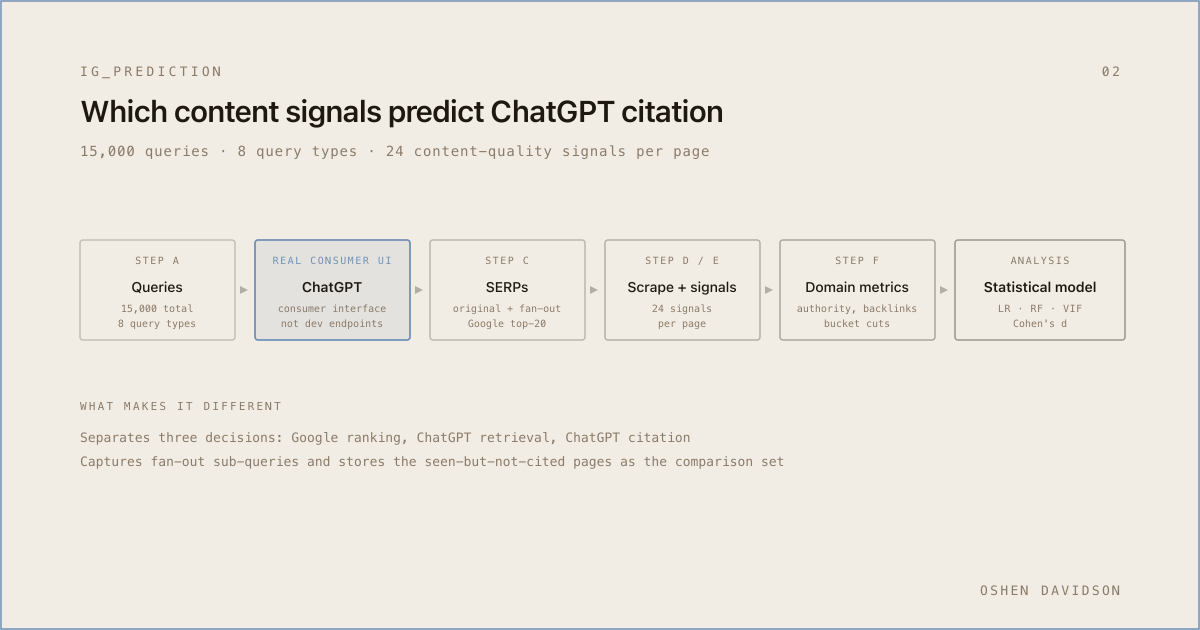
Content Quality Data Pipeline
15,000-query empirical research pipeline measuring which content quality signals predict ChatGPT citation. Six idempotent pipeline steps collect ChatGPT responses through the real consumer interface, join against Google SERP data for original and fan-out queries, extract 24 content quality signals per page, and run multi-method statistical analysis.
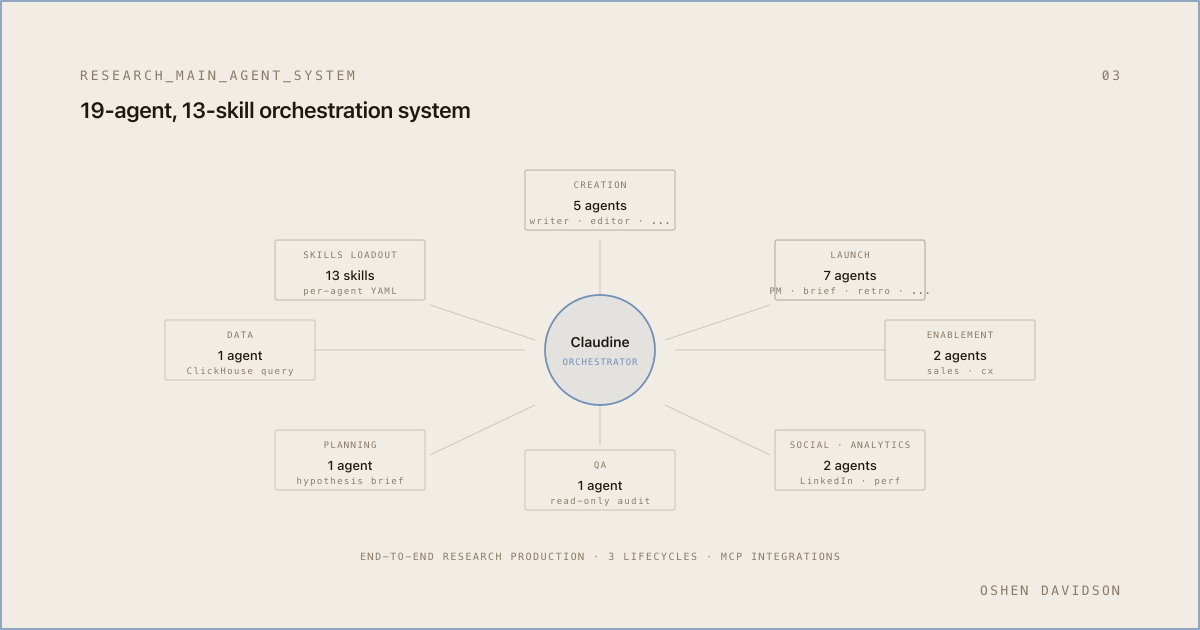
AirOps Research Agent System
19-agent, 13-skill multi-agent orchestration system running end-to-end research report production at AirOps. Plugin-style YAML-defined agents with per-agent skill loadouts, three lifecycle maps (full report, micro-report, insight drip), per-agent session memory, and cross-tool MCP integration across Notion, Slack, Asana, AirOps, ClickHouse, and Google Workspace.
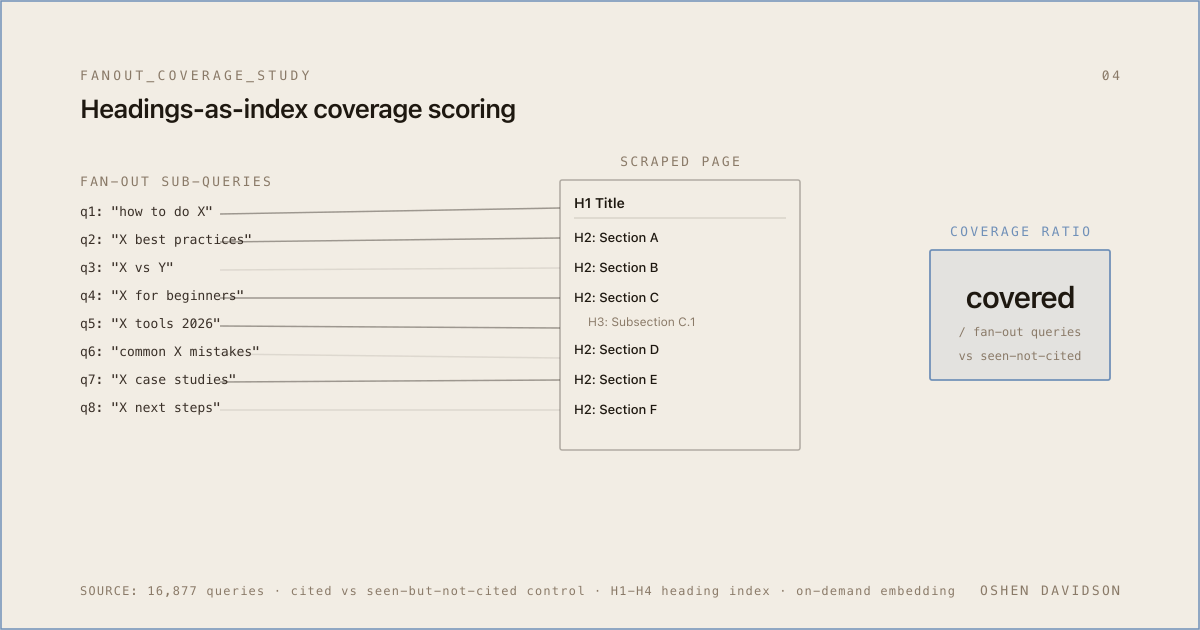
Fan-Out Coverage Study
16,877-query observational research pipeline measuring whether ChatGPT cites pages that cover more of its internal fan-out sub-query space, against a deterministic seen-but-not-cited control group. Queue-orchestrated multi-worker pipeline with novel headings-as-index coverage scoring and on-demand section-text embedding.
As Featured In
- Zyppy
- Search Engine Land
- MSN
- eMarketer
- MSN Deutschland
- Forrester