Citation Selection in Commercial AI Search: A Stage-Based Analysis of Retrieved Pages
What separates pages that ChatGPT cites from pages it retrieves and discards, conditioned on commercial intent. 217,508 retrieved pages across 7,500 commercial prompts, segmented by buying-journey stage and analyzed under four cross-checked analytical passes.
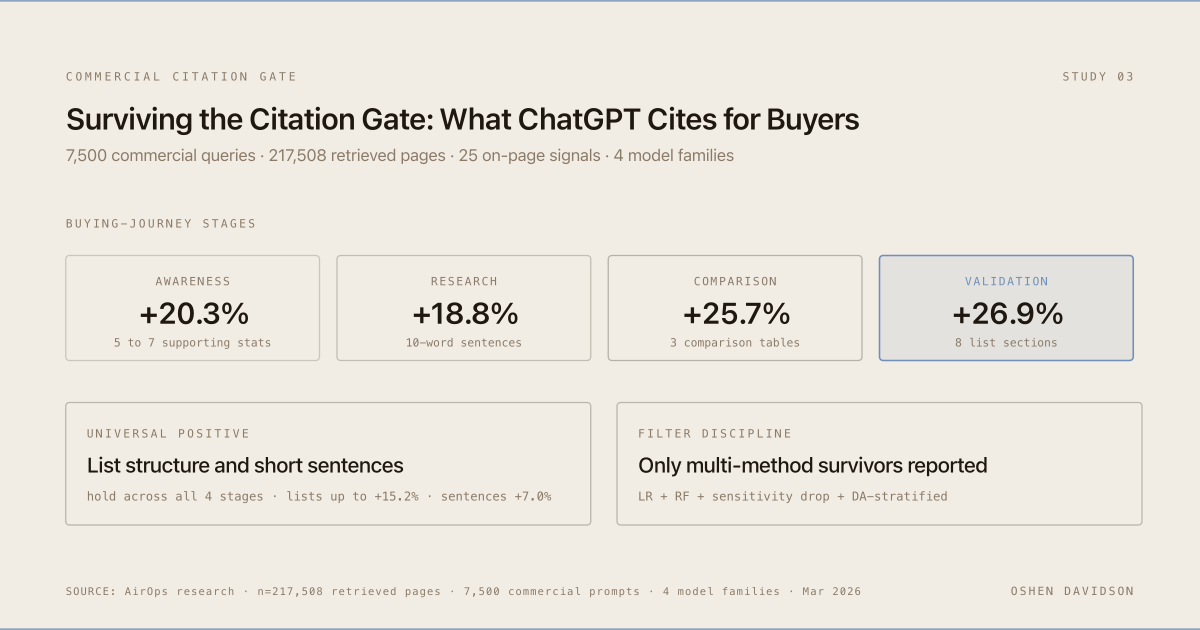
The earlier Search-to-Citation Funnel study found that ChatGPT retrieves roughly six pages for every one it cites. Eighty-five percent of the pages that enter the retrieval pool are dropped at the citation gate, never appearing in the final response. That ratio holds across most prompt types, but the why changes meaningfully when the user is in a commercial frame of mind.
Commercial queries are the prompts that matter most for revenue: people asking what tools exist, which options to shortlist, how two products compare, and whether a specific feature is supported. These are the prompts where AI search actively shapes a buying decision.
They are also the prompts where the citation gate is most informative, because the user’s intent is identifiable from the phrasing of the query alone. A page can be cited at one stage and discarded at the next without anything about the page changing.
That stage-dependency is the question this study is built around.
Research question
Once a page enters ChatGPT’s retrieval pool for a commercial query, which on-page signals separate cited pages from retrieved-but-not-cited pages? Which signals hold across the full commercial set, and which are specific to a stage of the buying journey?
Dataset
The commercial subset of the dataset used in the earlier retrieval-and-fan-out study, captured against GPT-5.1 (ChatGPT’s real consumer interface), the surface end users actually see.
- 7,500 commercial queries
- 217,508 pages retrieved by ChatGPT during answer generation
- 1,875 queries per buying-journey stage, four stages
| Stage | Intent | Example query |
|---|---|---|
| Awareness | What solutions exist for a problem | ”tools to manage marketing experiments” |
| Research | Best or top options within a category | ”best project management software for startups” |
| Comparison | Head-to-head between named products | ”HubSpot vs Salesforce” |
| Validation | Specific product details (pricing, features, compatibility) | “Asana free plan user limit” |
Stages were assigned by query phrasing patterns developed in the earlier study. The classification is treated as a clustering variable, not a ground-truth label; in practice a single user can be at any stage on any query type.
Methodology
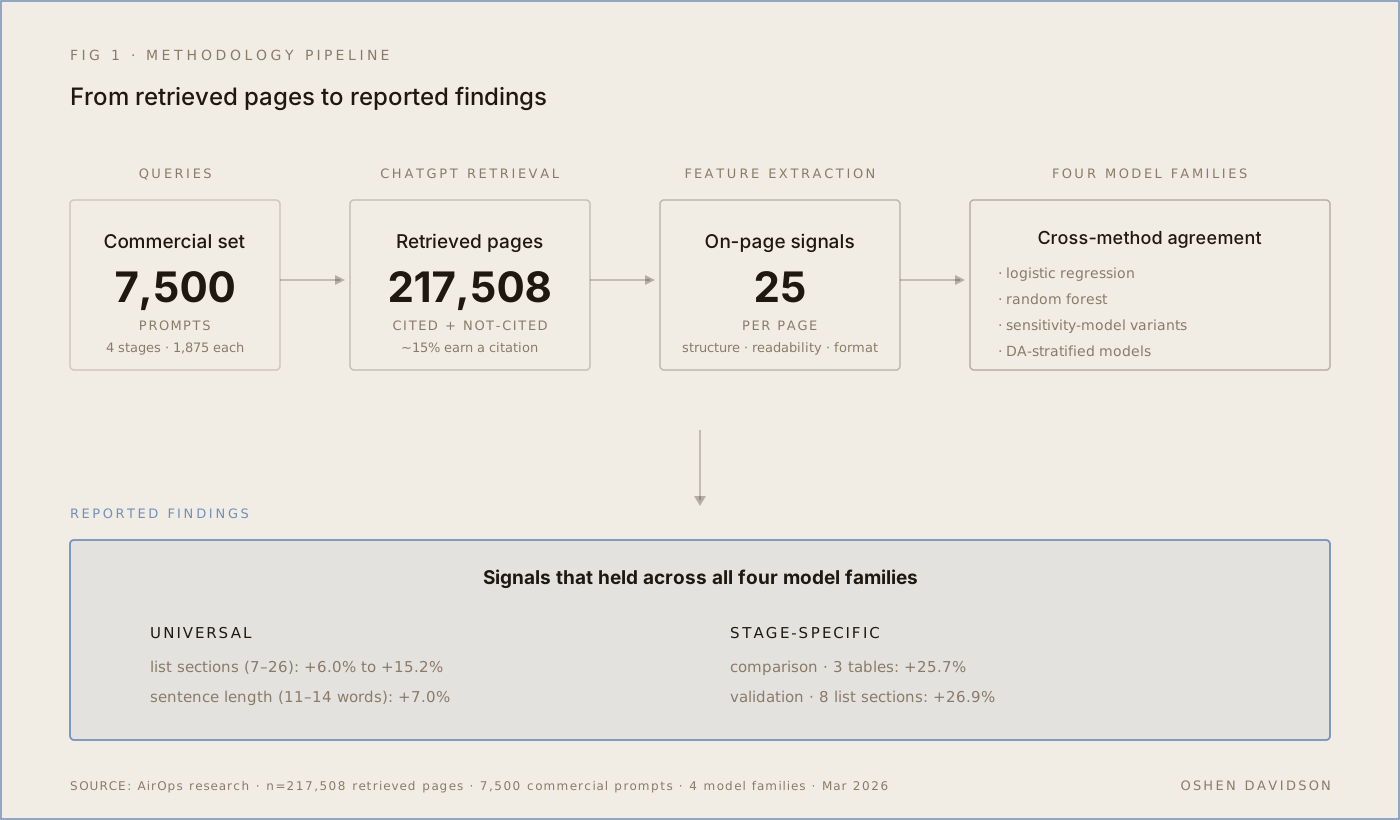 Fig. 1. 7,500 commercial queries through ChatGPT yield 217,508 retrieved pages. 25 on-page signals are extracted per page. Cited pages are compared against retrieved-but-not-cited pages within each buying-journey stage under four analytical passes. Only signals that hold under all four are reported.
What gets extracted
25 signals per page, grouped into four families. Representative signals from each family (the full set is 25):
- Structure: heading count, heading alignment with query terms, section count, list section count, table count, image count
- Readability: average sentence length, average section length, word count, paragraph length distribution
- Formatting: bullet density, schema markup presence, internal link count, external link count, distinct anchor-text count
- Evidence: statistic count, statistic type (revenue / efficiency / conversion / other), quote count, distinct price-point count
Four analytical passes, cross-method agreement
For each stage, the cited-vs-not-cited comparison was run under four analytical passes (two model families plus two robustness procedures applied on top of them):
- Logistic regression with standardized features, used to recover signed effect estimates and confidence intervals.
- Random forest with 500 trees and out-of-bag estimation, used to rank feature importance without assuming linearity.
- Sensitivity-model variants that drop one feature at a time and refit, to surface variables whose effects depend on correlated peers.
- DA-stratified models that rerun the comparison separately inside each domain authority bucket (0-20, 20-40, 40-60, 60-80, 80-100), to surface signals confounded by DA.
A signal was reported as a finding only if its effect held in the same direction under all four passes. The filter cuts roughly half of the initial coefficient-level results and is the methodological discipline this study is built on.
The reported numbers (e.g., +25.7%) are citation-lift percentages: how much more likely a retrieved page with the given signal characteristic is to be cited, relative to retrieved pages in the same stage without it. They are association strengths, not causal effects.
Universal patterns
Two signals held across all four buying-journey stages and survived every sensitivity check.
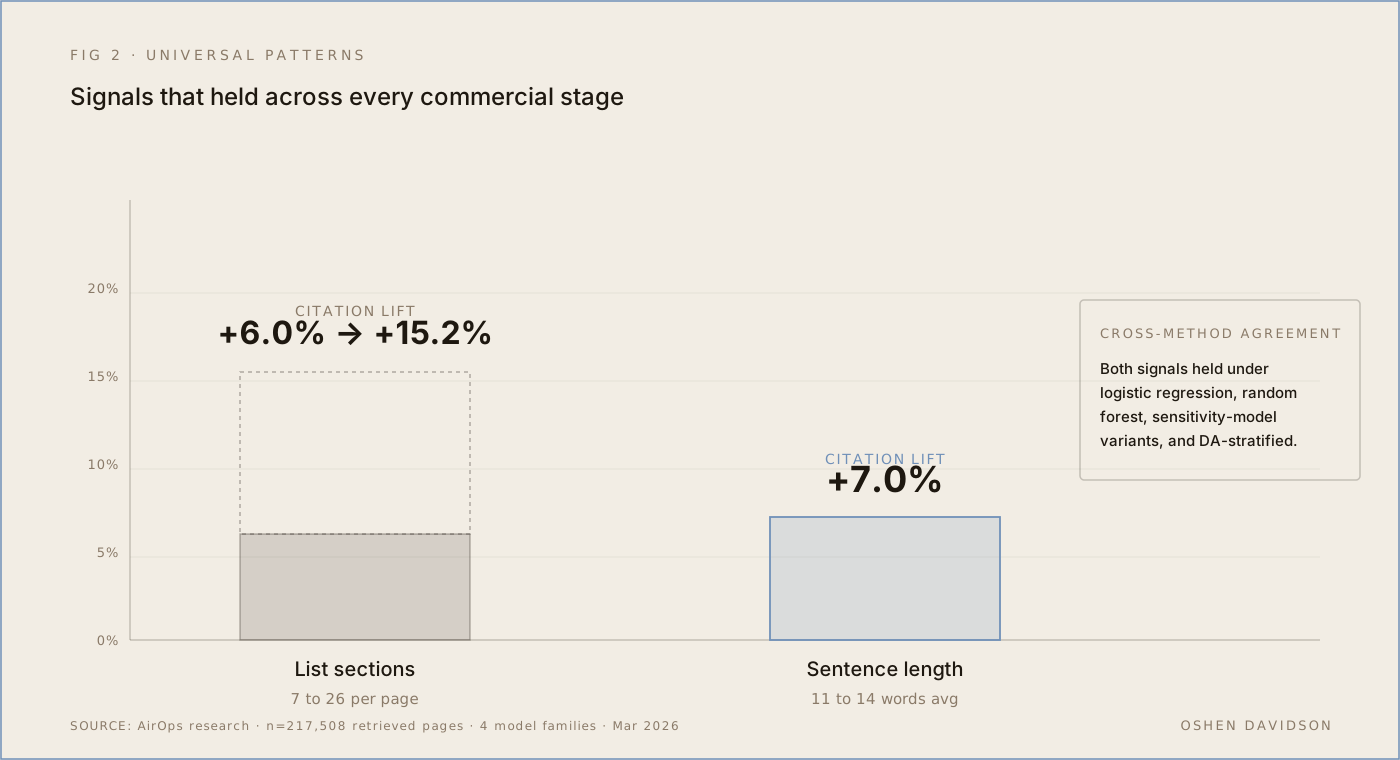 Fig. 2. The two on-page signals that lift citation rate across awareness, research, comparison, and validation queries. List sections scale with the upper end of the range. Sentence length is a single-point effect.
List structure
Pages with 7 to 26 list sections were 6.0% to 15.2% more likely to earn a citation than retrieved-but-not-cited pages. The effect size scaled with the upper end of the range.
The direction held inside every DA bucket and survived all three sensitivity drops (word count, table count, heading count). List sections were the single most universal positive signal in the study.
Sentence length
Pages averaging 11 to 14 words per sentence had a 7.0% higher citation likelihood across all four stages. The effect was stable under sensitivity-model variants and held inside DA-stratified buckets. The signal sits inside a narrow band: pages averaging fewer than 8 words per sentence saw no lift, and pages averaging more than 18 words per sentence saw a small negative effect.
Both signals point in the same direction. Cited pages are structurally easier to extract from. The model is selecting for pages where the answer to the user’s prompt sits in a discrete, addressable unit, not buried inside a paragraph that has to be summarized down.
Stage-specific patterns
The universal signals are the floor. The differentiation happens stage by stage.
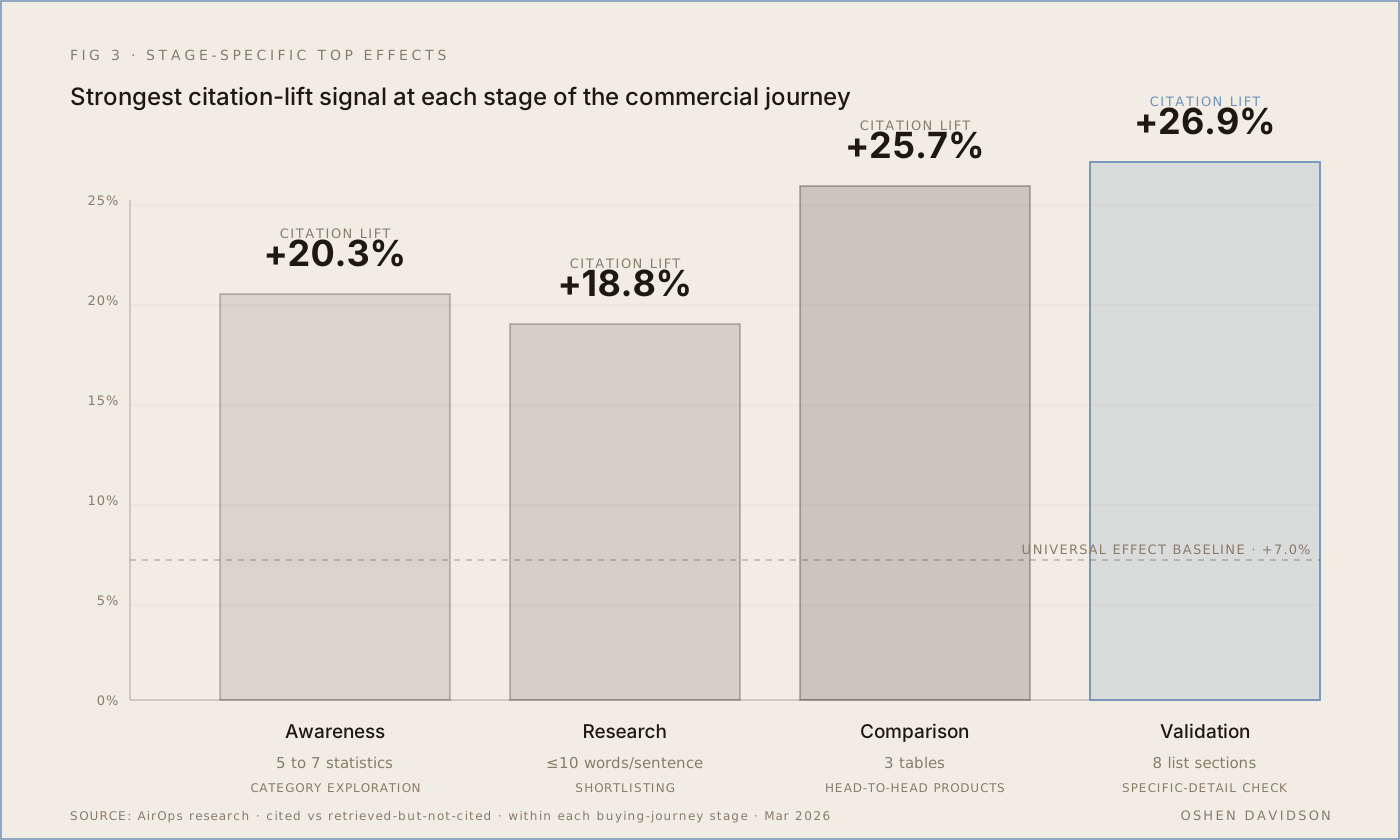 Fig. 3. Strongest citation-lift signal at each commercial stage. Validation and comparison queries reward structure more aggressively than awareness and research. The dashed line marks the universal sentence-length effect (+7.0%) for scale.
Awareness · category exploration
For queries where the user is identifying which categories of solutions exist:
- Pages containing 5 to 7 statistics to support claims earned a 20.3% higher citation likelihood. Statistic types most frequently associated with cited pages were quantitative impact figures: revenue impact, efficiency gains, conversion improvements. Generic counts (“over 100 features,” “thousands of users”) were not associated with a lift.
- Pages between 1,301 and 1,500 words earned a 10.8% higher citation likelihood. Above 1,800 words the effect inverted; awareness queries appeared to penalize length once the page crossed into exhaustive-overview territory.
The signal at this stage points to a specific kind of page: a moderate-length explainer that defines the category, names the solution types, and grounds the framing in quantitative claims. ChatGPT appears to weight pages that can ground the category framing in numbers, rather than pages that try to be comprehensive about every option.
Research · shortlisting
For queries that surface a ranked or shortlisted set of category options:
- Pages with sentences averaging 10 words or less earned 18.8% more citations. The threshold sits below the universal 11-14 word band, suggesting the shortlisting stage rewards concision more aggressively than the average commercial query.
- Pages with 10 images earned 16.4% more citations. The effect peaks around 10 and declines on either side; pages with two or three images underperformed pages with none.
- Pages between 1,501 and 1,800 words earned 8.4% more citations.
The pattern matches the cognitive task. The user is comparing several candidate products in parallel. Sentences that can be scanned at a glance and images that visually separate one option from another both reduce the cost of building a mental shortlist.
The 200-word lift over the awareness band is small and consistent with shortlisting pages needing slightly more breathing room to cover each option.
Comparison · head-to-head
For queries that ask for direct comparison of named products:
- Pages with 3 tables earned 25.7% more citations. This is the largest single effect size observed in the study.
- Pages with 7 distinct price points earned 15.7% more citations. The signal interacts with the table signal; pages with both tables and dense pricing detail outperformed pages with either alone.
The comparison stage is the cleanest case for structured data. Two named products, several criteria, and a user trying to evaluate them along the same dimensions.
Tables externalize the comparison structure. Pricing detail closes the loop, because pricing is the dimension users most often anchor their choice on.
Validation · specific-detail check
For queries that surface a single specific detail (pricing, feature presence, compatibility):
- Pages with 8 list sections earned up to 26.9% more citations. This is the largest stage-specific effect in the study, narrowly edging out the comparison-tables finding.
- Pages with 15 or more price points earned 11.0% more citations.
Validation queries are different from the other three stages: the user already knows what they want and is checking a fact. The page that earns the citation is the one that surfaces the fact fastest.
Enumerated list structure does that mechanically. Pricing pages, feature lists, and integration-compatibility documentation are the canonical examples; the citation gate rewards pages built for quick verification over pages built for narrative.
Discussion
Three patterns are worth surfacing beyond the individual findings.
Length is not the dominant signal. Across all four commercial stages, the citation lift correlates with structure and parsability, not length. Where length appears as a finding, the effective range is moderate (1,301-1,500 words for awareness, 1,501-1,800 for research).
The 1,800-word ceiling is consistent across the stages where length appears, and the awareness band actively penalizes content above it. The legacy SEO assumption that longer and more comprehensive content wins does not generalize to ChatGPT’s citation behavior on commercial queries.
Stage drives signal selection more than category. The citation gate applies different criteria depending on inferred commercial intent.
Comparison queries reward tables. Validation queries reward enumerated list structure. Awareness queries reward grounded quantitative claims.
The variation across stages is large enough that treating commercial content as a single class would obscure most of the signal: the 26.9% validation effect is 3.8 times the universal sentence-length effect.
A unified model trained on the flat commercial dataset would assign roughly average effect sizes to all of these signals and rank them well below DA. Stratifying by stage is what makes the structural signals visible at all.
The two strongest effect sizes are both about list/table structure. The comparison-tables finding (25.7%) and the validation-list-sections finding (26.9%) sit at the top of the effect-size ranking and both describe the same underlying behavior: pages that externalize structured information into discrete addressable units. Whatever else the citation gate is doing on commercial queries, it is reliably preferring pages where the answer can be lifted out without paraphrasing.
Limitations
- ChatGPT-specific: The dataset captures retrieval and citation behavior against ChatGPT’s real consumer interface. Generalization to Claude, Perplexity, or other AI-search engines is not claimed and would require replication on those surfaces.
- On-page signals only: Off-site signals (link graph, third-party brand mentions, presence in independent reviews) are outside the scope of this analysis. The Cross-Model Brand Discovery: Measuring First-Party and Third-Party Source Shares study covers off-site behavior separately, and the two effects compound in practice.
- Inferred buying-journey stage: Stages were assigned by query phrasing, based on what the search industry knows regarding user search intent and behavior. A user can ‘technically’ be at any stage on any query type; the classification is a clustering variable for analysis based on traditional search analysis metrics and what we know about search intent and user behavior.
- Effect sizes are associations. The reported lifts describe what cited pages look like in this dataset, not the expected outcome of editing a page to match. Causal claims would require an intervention study (publishing a controlled set of variants and observing citation rates over time).
- Domain authority is partially controlled. The DA-stratified models confirm the signals hold inside each DA bucket, but the cross-bucket interaction is not modeled in the headline numbers. The bucket-level breakdowns are in the underlying analysis.
Related work
- From Search to Citation: Measuring How ChatGPT Retrieves and Selects Sources: the source dataset, retrieval-pool analysis, and broader methodology this study draws from. The 85%-retrieved-never-cited finding from that study is the gate this study examines.
- Cross-Model Brand Discovery: Measuring First-Party and Third-Party Source Shares: the off-site signal layer that complements the on-page signals analyzed here.
This research was first published as an AirOps report.