Cross-Model Brand Discovery: Measuring First-Party and Third-Party Source Shares
Where AI search engines actually find brands. 21,311 brand mentions across ChatGPT, Claude, and Perplexity analyzed for first-party vs. third-party share, content type, and cross-model consistency.
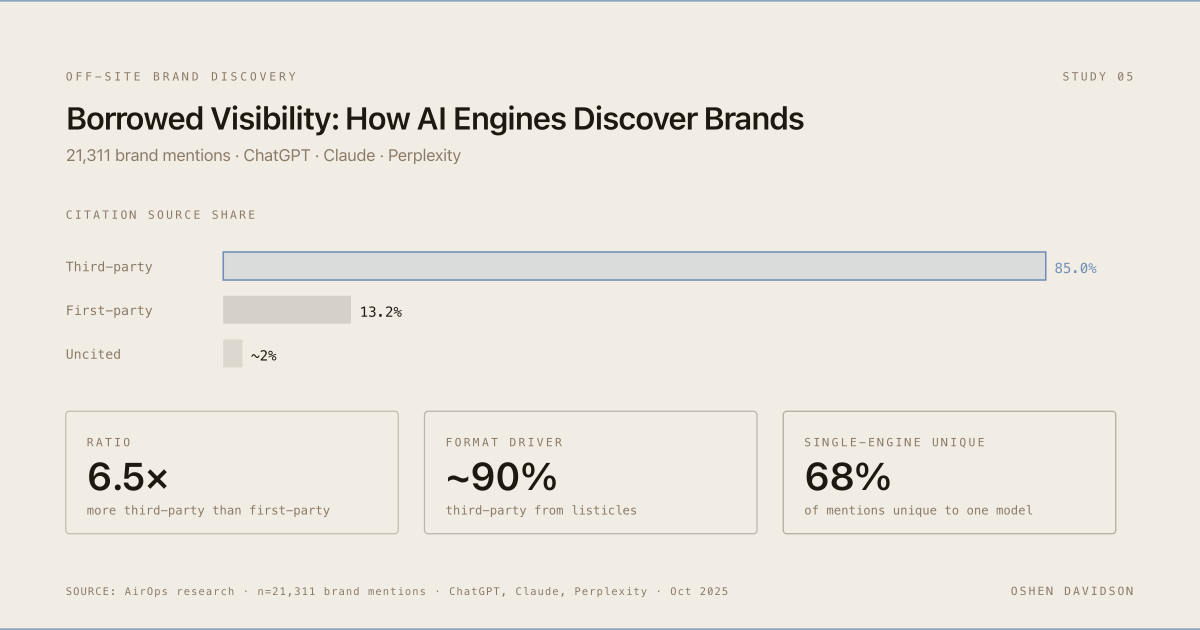
Brands that rely only on their own content for AI search visibility are losing the citation game before it starts. Across three frontier AI search engines, citation share lives off-site.
This study quantifies the share, identifies which content types carry it, and tests how consistent the pattern is across ChatGPT, Claude, and Perplexity.
The headline finding is large enough to reframe the strategy. The cross-model variance is large enough to complicate it.
Research question
What share of brand mentions across the major AI search engines come from third-party sources vs. brand-owned content? Which content types carry the third-party share, and how consistent is brand visibility across the three engines?
Dataset
21,311 brand mentions across GPT-5 (ChatGPT), Claude Sonnet 4.5, and Perplexity Sonar.
Each mention classified by source type:
| Source type | What it captures |
|---|---|
| First-party | Citation from the brand’s own domain |
| Third-party | Citation from an external domain |
| Uncited | Brand referenced in answer text without a citation link |
Each mention also tagged by content type (listicle, product page, homepage, review-platform listing, community thread, news article, etc.) and by AI model.
Methodology
21,311 brand mentions captured across ChatGPT, Claude, and Perplexity over a defined measurement window. Brand mentions were surfaced via NER and matched against a curated brand registry, with variants and acronyms aliased to a canonical brand ID.
Each mention was linked to its source URL when the model rendered a citation link, then classified as first-party (cited domain matches the brand’s owned domain set), third-party (cited domain is external), or uncited (brand named in body text without an attached source link).
Content-type tagging assigned each cited URL to one of: listicle, product page, homepage, review-platform listing, community thread, news article, blog post, or other.
Cross-model consistency was tested by tracking the same brand-query pair across the three engines. Brand visibility was treated as consistent only when at least two of the three engines surfaced the same brand for the same query.
Statistical tests: chi-square for source-type distribution differences across engines, McNemar for paired cross-engine consistency, and engine-stratified bucket re-estimation as a robustness check.
Third-party sources carry the citation share
Across all models analyzed, 85% of brand mentions came from external domains. Only 13.2% of mentions came directly from brand-owned domains. The remaining ~1.8% of mentions were uncited (brand named in body text without a source link).
Brands were 6.5× more likely to be mentioned through third-party sources than through their own domain.
The direction held in each of the three engines; the volumes differ per engine (see the single-model visibility section below).
Listicles drive 9 in 10 third-party mentions
Nearly 90% of third-party mentions came from listicle-format content. Among these instances, 80% of brands appeared as one of the first three companies listed in the listicle.
The listicle effect is mechanical: ranked-list content with clear comparative structure is the format AI search engines pull from most reliably when surfacing brands. Position within the listicle matters: top-three appearances dominate the visibility share.
Product pages and homepages drive 26% of first-party visibility
Among the 13.2% of mentions that came from brand-owned domains:
| First-party content type | Share of first-party mentions |
|---|---|
| Product pages | 19.3% |
| Homepages | 7.1% |
| Other brand-owned content (blog, docs, etc.) | ~73.6% |
Product pages and homepages together account for 26% of first-party brand visibility, making them the two largest single content types. The remaining ~74% spreads across blog content, documentation, and supporting pages in aggregate, with no single page type carrying comparable weight.
68% of brand visibility is unique to one model
AI search visibility is highly variable across systems. 68% of the brand-query pairs captured in the dataset surfaced in only one of the three engines (ChatGPT, Claude, or Perplexity).
That number is the cross-model consistency floor. Two-thirds of the time, a brand earning visibility on one engine is not earning the same visibility on the other two for the same query.
A small share of brand-query pairs (the consistently-cited brands) appeared across all three engines; this is the brand-visibility ceiling. The vast middle is single-engine visibility that does not generalize.
Discussion
Three patterns are worth surfacing.
Owned content is the floor, not the ceiling. A brand’s own domain is necessary for the 13.2% first-party share, but the 85% off-site share is where the visibility lives. Marketing programs that focus on owned-content production without parallel third-party signal investment are optimizing for the smaller of the two layers.
Listicle position is a leverage point. Top-three appearance in listicles accounts for the majority of brand citation share. That makes outreach, partnership, and category-listing strategy a primary visibility investment, not a supplementary one.
Cross-engine strategy is necessary. With 68% of brand-query visibility unique to one model, optimizing for any single engine produces only a third of the achievable visibility. The brand-visibility leaders in the dataset are the brands earning visibility across the engines, not the brands maximizing share on any one of them.
Limitations
- Three-engine snapshot. Captured during a defined measurement window. Brand visibility shifts over time and across new engine releases.
- Sampled brand set. A specific brand sample was analyzed. Patterns are consistent within the sample; generalization to all brand categories has not been claimed.
- Mention attribution. Uncited mentions were counted only when the brand was named explicitly in body text. Implicit references (e.g., paraphrases) were not captured.
- No causal claim. Brands with strong third-party share are not assumed to be cited because of their third-party share. The data describes which sources carry the visibility, not the mechanism by which any one brand earns that visibility.
Related work
- Community Sources in AI Search: A Cross-Model Analysis of 5.5 Million Answers: the deeper breakdown of which third-party platforms carry the citation share (Reddit, YouTube, LinkedIn, Wikipedia, review platforms).
- Measuring Citation Volatility in AI Search: A Repeated-Run Study of Source Stability: the run-to-run volatility that explains why single-engine visibility undercounts true reach.
This research was first published as an AirOps report.