Community Sources in AI Search: A Cross-Model Analysis of 5.5 Million Answers
How user-generated content and community platforms shape brand visibility across ChatGPT, Perplexity, Gemini, and Google AI Mode. 5.5M answers and 61K queries analyzed across 821,000 cited domains.
The Cross-Model Brand Discovery: Measuring First-Party and Third-Party Source Shares study established that brand citation share lives off-site, not on owned domains. This study takes the next step.
Among off-site citations, which sources carry the citation weight, and which AI search engines treat them as authoritative? We analyzed 5.5M answers across four answer engines (ChatGPT, Perplexity, Gemini, Google AI Mode) to map the UGC and community-platform layer.
The finding is consistent across engines: peer validation is the dominant trust signal shaping which brands appear in AI search.
Research question
Across the four major AI search engines, what share of brand citations come from user-generated content and community platforms? Which platforms carry the citation share, and how does that share differ across answer engines?
Dataset
5.5M answers to 61K+ queries across ChatGPT, Perplexity, Gemini, and Google AI Mode, captured between October 1 and October 23, 2025.
- Answer engines covered: ChatGPT, Perplexity, Gemini, Google AI Mode
- Cited domains tracked: 821,000+
- Query types: branded and non-branded
Citations were classified into four UGC categories:
| Category | Platforms |
|---|---|
| Community Q&A | Reddit, YouTube, GitHub, Quora, Stack Overflow, Stack Exchange |
| Social | LinkedIn, X, YouTube |
| Community editorial | Wikipedia, arXiv, Medium |
| Reviews / Ratings | G2, Trustpilot, TrustRadius, Capterra, Product Hunt |
Methodology
61,000 unique queries submitted to each of four engines (ChatGPT, Gemini, Perplexity, Google AI Mode) against their live consumer interfaces, yielding 5.5 million answers across 821,000 unique cited domains. Each query spanned 12 industry verticals and 4 intent types (brand-specific, category-level, comparative, factual).
For each answer, every citation was extracted and classified by source domain against a curated platform-to-category map spanning the 4 UGC categories above. Citations were bucketed at two levels:
- Answer level: fraction of answers citing at least one source from category X (breadth).
- Citation level: fraction of all citations from category X (depth).
The same query set was used across all four engines so engine-level variance reflects model behavior rather than query-set bias. Engine-level UGC shares were compared with chi-square against the pooled baseline.
UGC platforms influence 48% of AI search results
Across the four engines, user-generated content and community platforms appear in 48% of AI search answers.
The share varies sharply by engine. Perplexity references UGC and community platforms in more than 90% of answers. Gemini surfaces these domains in as few as 7% of answers.
ChatGPT and Google AI Mode sit between those poles. The variance across engines is the most striking finding: each model treats peer-validated content very differently.
Reddit is the single largest UGC source
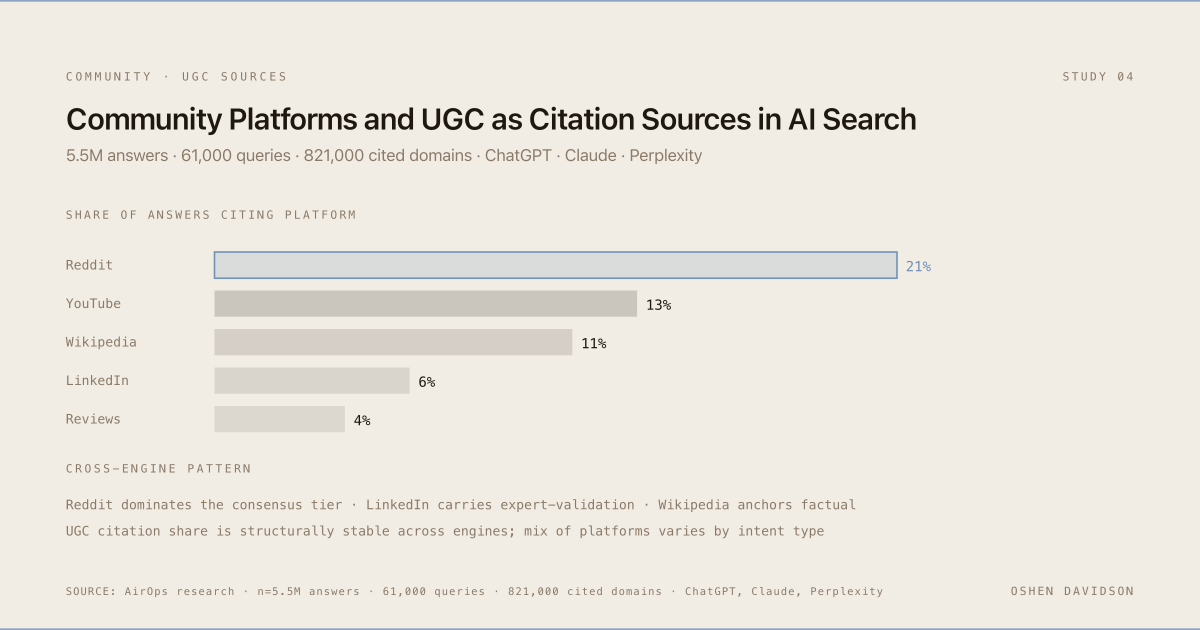
Reddit alone appears in 21% of all AI search answers across the four engines. Reddit’s citation share varies by engine, with Google AI Mode citing Reddit in ~22% of answers.
Reddit citations concentrate on category queries
88% of Reddit citations come from category-related queries (questions about a category, comparison, or recommendation). Only a small share of Reddit citations come from brand-specific or factual queries.
The pattern aligns with how users actually use Reddit. It is the platform where category discovery and option-comparison conversations happen, and AI search treats those threads as the canonical source for those question types.
LinkedIn surfaces as the expert-validation source
LinkedIn citations cluster on queries where the model is looking for professional perspective or industry-specific context. The pattern is consistent across engines: when an answer needs expert validation, LinkedIn posts and articles carry that signal.
Citation volume from LinkedIn is smaller than Reddit overall, but on the subset of queries where it appears, it functions as the primary expert-context source.
YouTube and Wikipedia carry distinct loads
YouTube appears as both a community Q&A source (tutorial-style queries) and a social source (creator-specific queries). Wikipedia citations cluster heavily on factual, definitional, and category-overview queries. The two together cover a meaningful share of informational-intent citations across all four engines.
Discussion
Two patterns are worth surfacing.
Each engine has a different UGC tolerance. Perplexity is heavily UGC-weighted (90%+ of answers). Gemini is the opposite (as low as 7%). ChatGPT and Google AI Mode sit between. Cross-engine citation strategy cannot be one-size-fits-all: a brand maximizing Reddit and G2 presence will see different visibility across the four engines for reasons that have nothing to do with the brand’s content.
Peer validation is the dominant trust signal in AI search. Across the engines that surface UGC at all, the citation patterns concentrate on Reddit, YouTube, Wikipedia, LinkedIn, and review platforms. These are platforms where validation is collective and visible, and the concentration held across the query intents in the sample. This study did not measure traditional authority signals (DA, backlinks), so it makes no claim about how those compare; it measures where the citation weight actually lands.
Limitations
- Sampled brand set. The analysis covers a defined brand sample. Generalization across all categories has not been claimed; the patterns are consistent within the sample.
- 23-day window. Citation behavior shifts over time. The window captures the state during the measurement period, not a steady-state distribution.
- No causal claim. Brands cited via UGC are not assumed to be cited because of their UGC presence. The data describes which sources carry citation weight, not the mechanism by which any one brand earns that weight.
- Cross-engine attribution. Each engine renders citations differently. The classification scheme normalizes these but cannot guarantee identical semantics across engines.
Related work
- Cross-Model Brand Discovery: Measuring First-Party and Third-Party Source Shares: the broader off-site signal layer this study sits inside.
- From Search to Citation: Measuring How ChatGPT Retrieves and Selects Sources: the retrieval-to-citation funnel that determines which UGC sources surface for which queries.
This research was first published as an AirOps report.