From Search to Citation: Measuring How ChatGPT Retrieves and Selects Sources
How ChatGPT moves from search to citation. 548,534 pages retrieved across 15,000 prompts analyzed to separate the retrieval decision from the citation decision, with rank-controlled six-model decomposition and DA × rank tier cross-stratification.
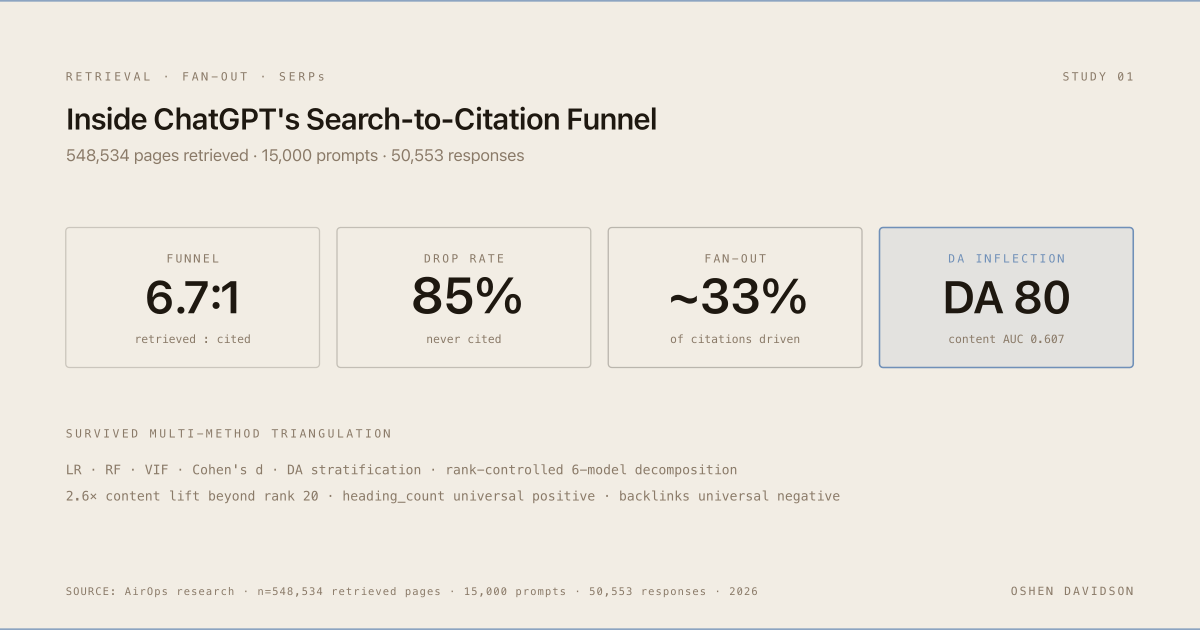
Getting a page cited in ChatGPT involves three separate decisions: which pages Google ranks for the query, which pages ChatGPT retrieves through its internal fan-out, and which retrieved pages ChatGPT chooses to cite in the answer. Each of those decisions is governed by different signals, and treating them as one obscures where a page is actually losing visibility.
This study separates all three across 15,000 prompts and 548,534 retrieved pages, capturing the behavior end users see (ChatGPT’s real consumer interface, not the developer-facing endpoints that surface a different retrieval pipeline). Every signal is tested under enough statistical controls to rule out the most common spurious findings.
Research question
How does ChatGPT move from search to citation? Specifically, what share of retrieved pages get cited, how much does fan-out contribute, and which on-page and authority signals predict citation when retrieval is held constant?
Dataset
15,000 original prompts against GPT-5.1 (ChatGPT, consumer interface), expanding to 43,233 total queries through internal fan-out.
| Dimension | Value |
|---|---|
| Unique prompts | 15,000 |
| Query types | 8 |
| Total queries after fan-out expansion | 43,233 |
| Retrieved pages analyzed | 548,534 |
| Authority providers | third-party DA and backlink APIs |
Two analytical populations were maintained separately:
| Population | Definition | Used for |
|---|---|---|
| Population 1 | Every URL in Google’s top-20 for any original or fan-out query | SERP-rank vs. citation analyses |
| Population 2 | Only pages ChatGPT actually retrieved (cited or not) | On-page signal analyses, logistic regression, random forest |
Mixing the two populations without flagging it is treated as a methodological error.
Methodology
15,000 original prompts against ChatGPT’s real consumer interface (not the API), expanding to 43,233 total queries through internal fan-out sub-queries. For every response: cited URLs, seen-but-not-cited URLs, and fan-out sub-queries were captured. Google top-20 SERPs were collected for the original query and every fan-out sub-query.
Each retrieved page (cited or not) was analyzed for 24 content quality signals across structure, readability, formatting, schema, and evidence-density families. Domain authority and backlink data were joined from third-party authority providers.
Statistical analysis: logistic regression, random forest, VIF screening for collinearity, Cohen’s d, Pearson / Spearman / point-biserial correlations, Mann-Whitney U, DA and backlink bucket stratification, and a rank-controlled six-model decomposition (rank-only, authority-only, content-only, rank+authority, content+authority, all combined).
A finding was reported only after surviving multiple-method agreement. Effects that appeared in logistic regression but disappeared under DA stratification or VIF correction were excluded.
The retrieval-to-citation funnel
Across the full 15,000-prompt dataset:
| Metric | Value |
|---|---|
| Pages retrieved per query | 36.6 |
| Pages cited per query | 5.5 |
| Overall retrieval-to-citation ratio | 6.7:1 |
| Share of retrieved pages never cited | 85% |
Eighty-five percent of pages that enter ChatGPT’s retrieval pool are dropped at the citation gate. The 6.7:1 ratio is the headline funnel statistic, and it is consistent across query types within a narrow band.
DA 80 is the empirical inflection
Below domain authority 80, on-page signals are near-random predictors of citation. Above DA 80, content signals begin to matter.
| DA bucket | Content-only AUC |
|---|---|
| 0 to 20 | 0.506 |
| 20 to 40 | 0.521 |
| 40 to 60 | 0.524 |
| 60 to 80 | 0.526 |
| 80 to 100 | 0.607 |
The legacy “DA 40 threshold” that appears in older SEO literature is not supported by the bucket-level data. The signal floor is essentially flat from DA 0 through DA 80, then jumps sharply at DA 80.
Beyond rank 20, content signals matter more
Inside the top-20 Google ranks, rank dominates. Beyond rank 20, the picture inverts.
| Rank tier | Content-only AUC | Notes |
|---|---|---|
| Top-20 ranks | 0.5295 | small content lift over rank-only |
| Beyond rank 20 | 0.5542 | larger content lift (1.8× the top-20 content lift over chance) |
| DA 80 to 100 beyond rank 20 | 0.621 | highest content-only AUC in the dataset |
The interaction between DA and rank tier surfaces the most actionable finding in the study: high-DA sites ranking beyond position 20 are where content quality has the largest marginal effect on citation.
Rank-controlled six-model decomposition
Treating “rank only” as the baseline understates content’s contribution because most rank-only models also implicitly include authority. The decomposition:
| Model | AUC |
|---|---|
| Rank only (true) | 0.6078 |
| Authority only | 0.5303 |
| Content only | 0.5394 |
| Rank + authority | 0.6319 |
| Content + authority | 0.5525 |
| All combined | 0.6346 |
The historical “rank only” figure (0.6319) was actually rank + authority. The corrected rank-only number is 0.6078. The all-combined model adds only 0.0027 over rank + authority, which is the universal content lift inside the top-20 ranks.
Signals that survived multi-method triangulation
Universal positive signal:
- Heading count. Positive in all 8 query types. 12× stronger for DA 80-100 vs. DA 0-20. Coefficient doubles beyond rank 20.
Universal negative signal:
- Domain backlinks. Universally negative across all query types. Cited pages come from domains with fewer backlinks. Niche relevance beats bulk authority.
Strong stage-specific signals:
- Title-query word overlap. Pages with 50%+ overlap earn a 2.2× citation lift over pages with under 10% overlap.
- Heading-query word overlap. Positive in all 8 query types, scaling with overlap percentage.
Fan-out behavior
ChatGPT generates fan-out sub-queries internally during browsing. The fan-out layer drives a third of citations on average.
| Fan-out pattern | Citation rate |
|---|---|
| Near-verbatim (fan-out closely matches original query) | 12.62% (best) |
| Added-year (fan-out adds a year qualifier) | 10.34% (worst) |
84.8% of queries generate exactly two fan-out sub-queries. The “sweet spot” is two-fan-out structure with near-verbatim relationship to the original query.
Commercial fan-out is structurally different
Commercial queries use 1.76× more split-queries (fan-outs that fragment the original query into independent sub-queries) than informational queries. But commercial queries cite 2 to 3 percentage points lower per fan-out pattern.
The pattern signals a citation selection problem rather than a discoverability problem. Commercial pages are surfacing in the retrieval pool at expected rates but losing the citation gate more often.
Discussion
Three patterns are worth surfacing.
Rank is necessary, content is amplifying. Inside the top-20 Google ranks, rank dominates. Beyond rank 20, content quality is where the marginal lift sits. The “high DA + beyond rank 20” cell (AUC 0.621) is where the legacy SEO playbook breaks down most cleanly.
The DA 40 threshold was an artifact. Below DA 80, content signals are near-random. The empirical inflection sits at DA 80, not DA 40. Authority floors that older SEO programs treated as threshold checkpoints do not survive bucket-level analysis.
Citation selection differs from discoverability. Commercial queries surface in the retrieval pool at expected rates but cite at lower rates per fan-out pattern. The bottleneck for commercial brand visibility is not retrieval; it is the citation gate downstream.
Limitations
- ChatGPT-specific. Generalization to Claude, Perplexity, or other AI-search engines is not claimed.
- 24 on-page signals only. Off-site signal layer (link graph, third-party brand mentions, community presence) is outside the scope of this study and covered separately by Cross-Model Brand Discovery: Measuring First-Party and Third-Party Source Shares.
- Authority data quality. DA and backlink data come from third-party providers. Provider-specific noise propagates through DA-stratified analyses.
- Effect sizes are associations. Causal claims would require an intervention study.
Related work
- Citation Selection in Commercial AI Search: A Stage-Based Analysis of Retrieved Pages: the commercial-intent slice of the citation gate, with stage-specific structural signals.
- Content Freshness as a Citation Signal: the freshness layer that compounds with retrieval rank.
- Cross-Model Brand Discovery: Measuring First-Party and Third-Party Source Shares: the off-site layer not covered by this on-page analysis.
This research was first published as an AirOps report.