Content Recency in ChatGPT Citations: Freshness Across Query Intent
The recency profile of pages ChatGPT cites. 4,000+ cited pages across 900 high-intent queries in 15 industries, analyzed by last-updated date, publish date, and query intent.
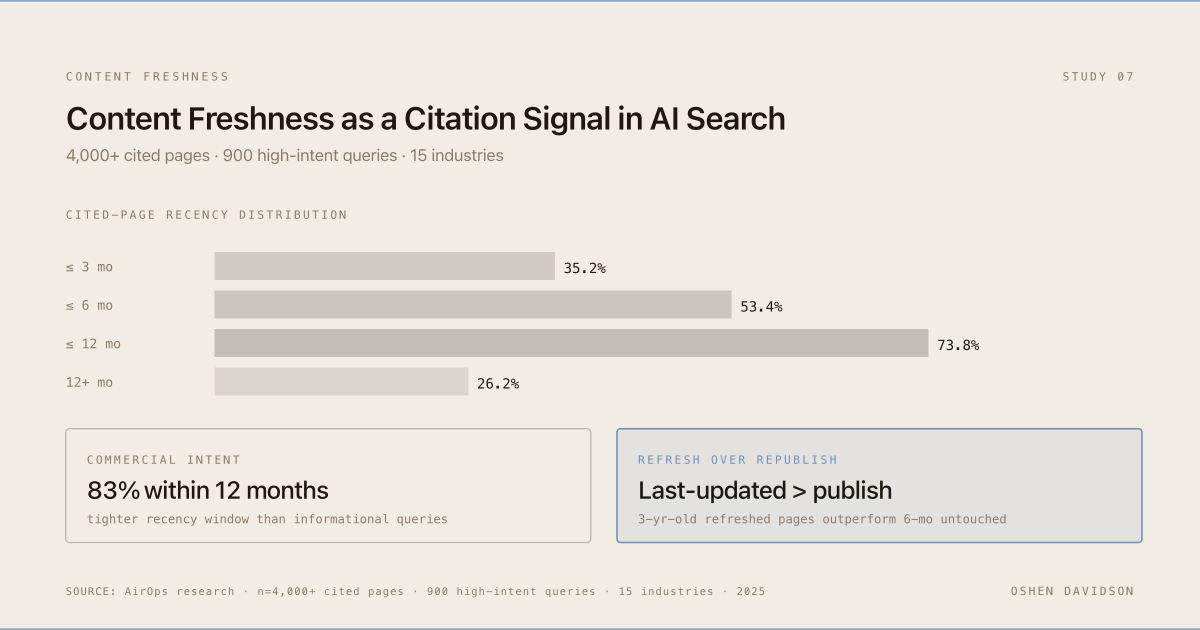
The “set it and forget it” content era is over. Pages that have not been touched in a year hold a sharply smaller share of AI-search citations, and the gap between fresh and stale is wide rather than gradual.
This study quantifies the citation cost of stale content and isolates which query types weight freshness most aggressively.
The pattern is sharp at the commercial end and softer for evergreen informational content, with one consistent floor across both.
Research question
What does the recency profile of ChatGPT-cited pages look like, and how does it differ across commercial vs. informational query intents? Among cited pages, does ongoing refresh show up more than recent publication?
Dataset
4,000+ cited pages across 900 high-intent queries in 15 industries, all captured against GPT-4o (ChatGPT, consumer interface).
| Dimension | Captured |
|---|---|
| Cited pages | 4,000+ |
| Source queries | 900 |
| Industries | 15 |
| Per-page attributes | last-updated date, original publish date, query intent, industry, content type |
Query intents in the dataset: commercial (active buying signal), informational (research-stage), mixed (queries that map to either).
Methodology
4,000+ cited pages from 900 high-intent queries across 15 industries. For each cited page, two dates were extracted from structured data, meta tags, or visible byline text: the last-updated date and the original publish date.
Pages were bucketed by months-since-update at 3, 6, and 12-month cut points. Citation patterns were measured separately by query intent (commercial, informational, mixed) to isolate the freshness signal from intent-driven variation.
A page was classified as refreshed when its last-updated date was at least 30 days after its publish date, allowing the analysis to test whether ongoing refresh of older content outperforms newer publication.
Statistical tests: chi-square for bucket-level distribution differences, Mann-Whitney U for citation-rate distribution by recency, and intent-stratified bucket re-estimation as a robustness check.
Freshness is now the baseline
More than 70% of pages cited by ChatGPT were updated within the past 12 months.
The recency distribution
| Update recency | Share of cited pages |
|---|---|
| Within last 3 months | 35.2% |
| Within last 6 months | 53.4% |
| Within last 12 months | 73.8% |
| 12+ months stale | 26.2% |
A third of all cited pages had been updated in the past three months. More than half within six months. The pool of cited pages skews aggressively toward recency.
Commercial queries weight recency most heavily
The freshness premium concentrates on commercial intent.
- Over 60% of commercial-query citations come from content updated in the past six months.
- Fewer than 1 in 5 commercial citations (17%) went to content older than a year.
- 83% of commercial-query citations were updated within the past 12 months.
Informational queries show greater tolerance for older content. Evergreen explainers and how-to guides can retain citation share for longer, especially in slower-moving sectors.
Mixed-intent queries (those that map to either commercial or informational depending on user context) show the highest recency rate of any category: 50% of mixed-intent cited pages were updated within the last three months.
Last-updated date matters more than publish date
For pages published more than a year ago, ongoing refresh restores citation eligibility.
- 26% of pages published more than a year ago had been updated in the last three months. Those pages compete with newly published content for citation share.
- Pages that have gone more than a year without an update hold 26.2% of citations, less than half the share held by pages updated within the past six months (53.4%).
Publish date is not the signal. Last-updated date is. A 3-year-old page that has been refreshed in the past quarter outperforms a 6-month-old page that has not been touched since publication.
Where stale content still earns citations
The 26.2% of cited pages that had not been updated in over a year concentrate in evergreen informational territory:
- 66% of that stale segment is evergreen how-to and best-practices content.
- The industry mix inside the segment skews to slower-moving sectors: Healthcare & Wellness, Personal Productivity, Travel & Tourism.
Even inside those slower-moving sectors, the freshness pattern shows up. Over 30% of cited Healthcare & Wellness content had been refreshed in the past six months, so the freshness premium reaches even the verticals where evergreen content holds on longest.
Discussion
Three patterns are worth surfacing.
Freshness is no longer a tiebreaker. Among cited pages, 73.8% sit inside the 12-month window. For commercial queries, the threshold tightens to six months. Pages outside the window are not competing for citation share on equal footing; they are competing at a structural disadvantage.
Ongoing refresh substitutes for new publication. The pages that hold their citation share are pages that get updated, not pages that are new. A consistent refresh cadence keeps the page in the cited pool. A “publish and walk away” cadence forces re-publication every 12 months to maintain the same citation share.
Decoupling from SEO traffic. My read of the citation-side data is that the freshness signal is enforced more strictly at the citation gate than at Google’s ranking layer (rankings were not measured in this study). If that holds, pages can keep their Google position while losing AI-search citation share, and teams measuring only traffic will see the drift late.
Limitations
- ChatGPT-specific. Generalization to Claude, Perplexity, or other AI-search engines is not claimed.
- Publish-vs-update date attribution. Last-updated dates were extracted from page metadata and structured-data signals. Pages with manipulated last-updated dates (touched without substantive change) cannot be distinguished from genuine refreshes in the dataset.
- Industry coverage. 15 industries were sampled. Generalization to industries outside the sample is not claimed; the directional pattern is consistent across the sampled set.
- No causal claim. The freshness premium describes what cited pages look like, not the expected outcome of refreshing a non-cited page.
Related work
- Citation Selection in Commercial AI Search: A Stage-Based Analysis of Retrieved Pages: the commercial-intent breakdown that this freshness study reinforces.
- Measuring Citation Volatility in AI Search: A Repeated-Run Study of Source Stability: the run-to-run volatility layer that compounds with freshness drift.
This research was first published as an AirOps report.