Measuring Citation Volatility in AI Search: A Repeated-Run Study of Source Stability
How visibility shifts run-to-run when the same query is asked of the same model. 45,000+ citations across 800 queries analyzed for consistency, reappearance, and the citation-vs-mention divide.
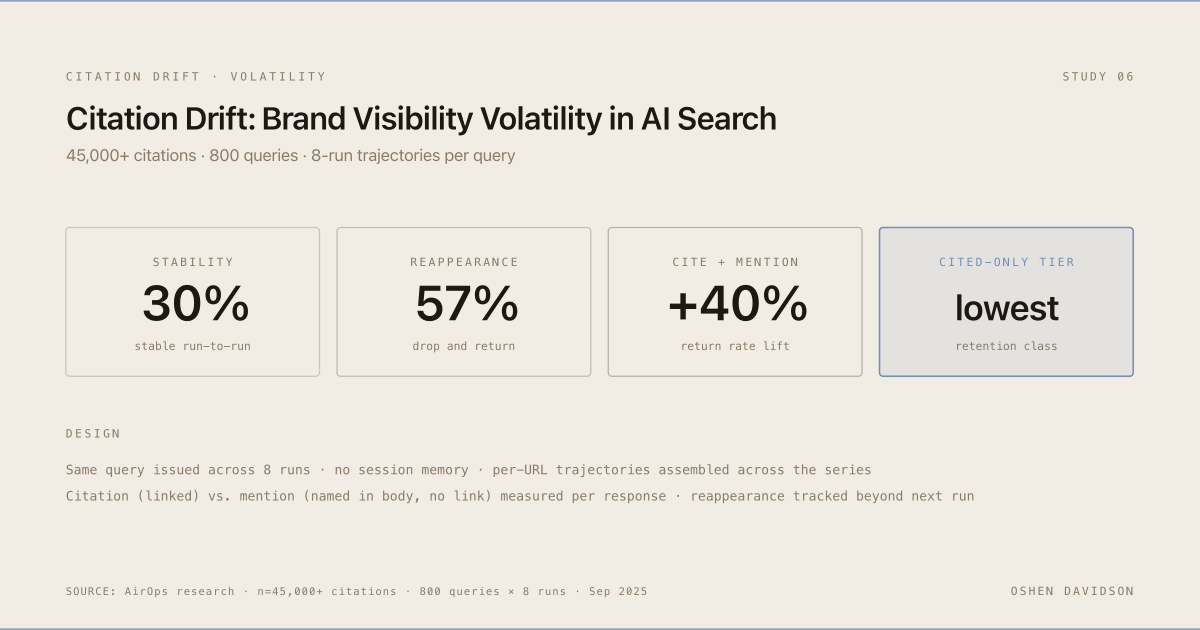
AI search does not deliver fixed results. The same query asked of the same model on two different sessions returns a different set of cited sources.
That volatility looks like noise from outside the system. From inside, it is a structural property of how LLMs select citations from a retrieval pool that varies run-to-run.
This study quantifies how much volatility is normal, which brands are stable, and what predicts whether a brand returns after disappearing.
Research question
When the same query is asked of an LLM across multiple sessions, how stable is the cited-source set? Do volatility patterns repeat in measurable ways, and does being cited and mentioned increase the probability of returning after a drop?
Dataset
800 queries × multiple runs against GPT-4.1 (ChatGPT, consumer interface), yielding 45,000+ citations.
| Dimension | Value |
|---|---|
| Unique queries | 800 |
| Total citations | 45,000+ |
| Query intent mix | 60% commercial / 40% informational |
| Query length emphasis | 7+ words (natural-language phrasing) |
Tracked measurements per URL per query:
- Consistency. How often a URL stayed visible across multiple runs of the same query.
- Mention vs. citation distinction. Whether the brand was cited as a source vs. mentioned in body text without a citation.
- Reappearance. How frequently dropped URLs came back in later runs.
- Retention. How long a URL stayed in the answer once it first appeared.
Methodology
800 queries, each issued across 5 separate runs of ChatGPT with no session memory between runs, yielding 45,000+ citations. Citations and mentions were extracted from each rendered answer.
Per-URL trajectories were assembled across the 5-run series. A URL was classified as stable when it appeared in consecutive runs, drifted when it dropped between consecutive runs, and reappeared when it returned at any later run.
The citation vs. mention distinction was measured per response: a citation links the source explicitly, a mention names the brand in body text without an attached link. Brand-query trajectories were partitioned into cited-only, mentioned-only, and cited-and-mentioned classes to compare reappearance rates.
Query mix: 60% commercial-intent, 40% informational-intent (commercial-weighted rather than perfectly balanced), skewed toward longer natural-language queries (7+ words) to reflect real-world AI search usage.
Statistical tests: bootstrap resampling for stability and reappearance confidence intervals, chi-square for class-level reappearance differences, and per-query trajectory normalization for queries with disproportionately many citations.
Citation drift is the new normal
Across 45,000+ citations, only 30% of brands maintained visibility from one run to the very next run.
That number is the headline volatility statistic. Seven in ten brands that earned a citation on one run did not earn the same citation on the immediately following run, even when the query was identical.
Reappearance is the rule, not the exception
When the analysis widens beyond consecutive runs:
| Pattern | Share |
|---|---|
| Stable across consecutive runs | ~30% |
| Reappeared in a later (non-consecutive) run | ~57% |
| Held visibility across all 5 runs in a series | ~20% |
Most brands that disappear from one response will resurface in a later one. The drop is rarely permanent. The takeaway is that single-run visibility measurements understate true visibility share, and stable-across-every-run visibility is the exception.
Citations and mentions together return more
The strongest predictor of reappearance is whether the brand was both cited and mentioned on the original visible run.
| Pattern on original run | Reappearance rate vs. citations alone |
|---|---|
| Citation only | baseline |
| Citation + mention | +40% |
A brand that earned both a citation and a mention on the run it was visible was 40% more likely to resurface in a later run than a brand that earned only a citation. Mention volume on top of citation acts as a stability signal.
The mention-vs-citation distinction matters
On average, 28% of LLM responses contained both citations and mentions. Mentions without citations were 3× more common than citations without mentions across the dataset. The two signals are not interchangeable: citations are link-level, mentions are name-level, and the combined signal carries the stability weight.
Discussion
Three patterns are worth surfacing.
The “fixed #1 position” era is over. Traditional SEO produced a stable ranking that, once earned, generally held. AI search is structurally different: every query is a fresh retrieval, every response is a fresh selection. Citation drift is built into the system.
Single-run visibility metrics undercount real visibility. A brand with 30% consecutive-run stability and 57% reappearance has a visibility footprint much larger than its appearance on any one query. Tracking visibility on a single-run basis (the default for most AI-search visibility tools) will systematically understate brand presence.
Mention volume is a stability lever. A brand that gets cited and mentioned is structurally more likely to be back next time. That suggests the stability lever is brand-name presence accumulated across the broader content set the model samples from. A single citation does not carry the same weight.
Limitations
- Single-model dataset. Volatility patterns were measured against one LLM at a time. Cross-model volatility (the same query producing different citation sets across ChatGPT, Claude, Perplexity) is a separate question covered by the Cross-Model Brand Discovery: Measuring First-Party and Third-Party Source Shares study.
- Same query, same session window. The runs were issued within a 23-day window. Long-horizon drift (citation patterns shifting month over month) is outside scope.
- Aggregated across query intents. Volatility patterns differ between commercial and informational queries. The headline numbers are pooled; intent-stratified breakdowns are in the underlying analysis.
- No causal claim about mention volume. Mention volume correlates with reappearance, but the direction of causation is not established. Brands with broad coverage tend to be both more mentioned and more reappearance-stable for reasons that may share an upstream cause.
Related work
- Cross-Model Brand Discovery: Measuring First-Party and Third-Party Source Shares: where the citations and mentions come from across off-site sources.
- Community Sources in AI Search: A Cross-Model Analysis of 5.5 Million Answers: the UGC layer that carries much of the mention volume.
This research was first published as an AirOps report.