Page Structure and ChatGPT Citation: A Comparison with Google-Ranking Controls
Which on-page structural attributes separate ChatGPT-cited pages from pages that rank on Google's first page but are not cited. 12,000+ URLs compared across schema, heading structure, lists, and bullets.
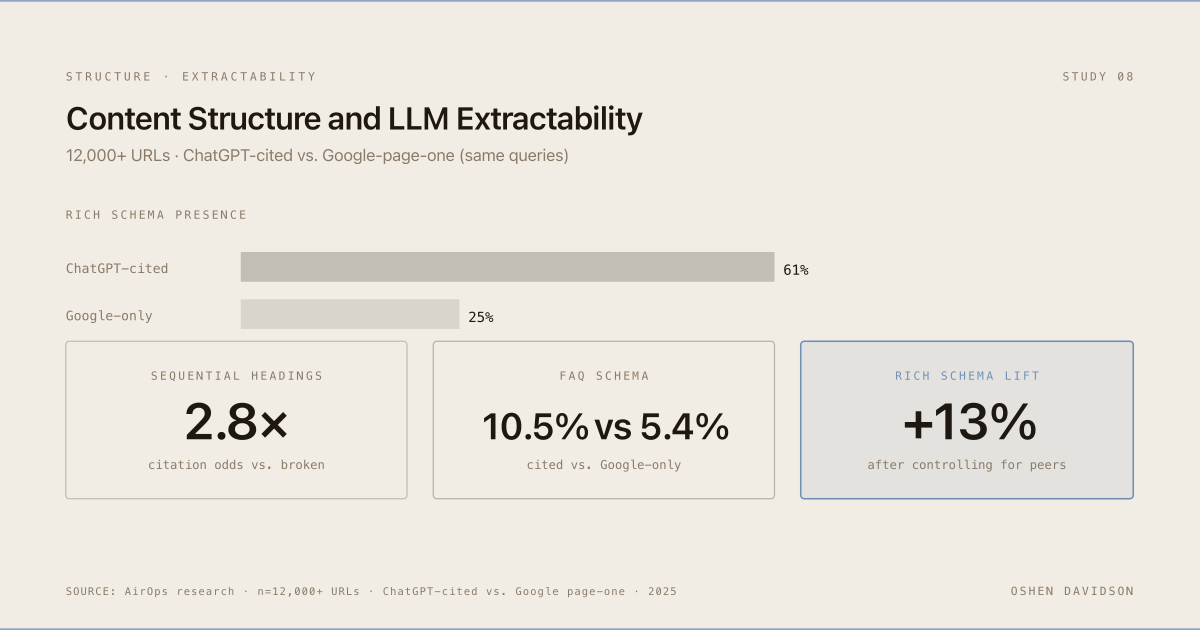
Ranking on Google’s first page is no longer sufficient for citation in ChatGPT. The two surfaces select pages differently.
This study takes the simplest possible question and answers it with controlled comparison: among pages that do rank on Google’s first page for a query, which structural attributes separate the ones ChatGPT cites from the ones ChatGPT ignores?
The answer is a small set of structural signals that align with technical SEO best practices and Google’s E-E-A-T guidelines, but with sharply different thresholds at the citation gate.
Research question
Among pages that rank on Google’s first page for high-intent queries, which on-page structural attributes predict whether ChatGPT will also cite them?
Dataset
12,000+ unique URLs analyzed against GPT-4o (ChatGPT, consumer interface), each individually reviewed for structural attributes. Two source sets:
| Source set | What it captures |
|---|---|
| ChatGPT citations | URLs cited in direct responses to high-intent queries |
| Google SERP leaders | URLs ranking on Google page one for the same queries, but not cited in ChatGPT |
This design holds the queries constant. The only difference between the two URL sets is whether ChatGPT picked them for the citation. Differences in structural attributes between the sets describe what ChatGPT looks for beyond Google ranking.
Methodology
Each URL was reviewed for structural attributes in three families.
Heading structure
- Whether the page has exactly one
H1element. - Whether the page’s headings are nested and ordered sequentially (no level skips).
Schema markup
- Whether the page contains any structured-data schema.
- Whether the page implements FAQPage or QAPage schema.
- Whether the page includes three or more distinct schema types.
Lists and bullets
- Whether the page contains at least one section with bullet points.
- Whether the page contains at least one section with an HTML list.
- Average number of distinct list-containing sections per page.
- Average number of distinct bullet-point sections per page.
Each attribute was measured as presence/count per URL. Citation status (cited by ChatGPT vs. Google-only) was the binary outcome variable.
Findings
Rich schema separates cited from uncited
| Schema attribute | ChatGPT-cited | Google SERP only |
|---|---|---|
| Rich schema present | 61% | 25% |
| FAQ schema present | 10.5% | 5.4% |
Rich schema is more than twice as common on cited pages (2.4× the Google-only prevalence). FAQ schema specifically nearly doubles. In the underlying report’s estimate, rich schema corresponds to a 13% higher likelihood of earning an AI citation.
Sequential heading structure lifts citation odds
Pages with headings nested sequentially (no skipped levels) earn citation odds 2.8× higher than pages with broken or non-sequential heading order. The signal is structural integrity: pages built with a clean H1 → H2 → H3 hierarchy are easier to extract from than pages where headings appear in arbitrary order.
The “exactly one H1” check is also stronger on cited pages, though the gap is smaller than the sequential-nesting effect.
Lists and bullets are common on cited pages
The structural difference around lists is directionally consistent: cited pages contain more sections with lists, more sections with bullets, and a higher average count of each. The per-set averages are not published here, so treat this finding as directional rather than quantified. It matches the quantified result in the Citation Selection in Commercial AI Search study, where list sections (7-26 per page) lift citation rate across commercial query stages.
Discussion
Three patterns are worth surfacing.
Ranking on Google is necessary but not sufficient. Every URL in this dataset already ranked on Google’s first page. The pages ChatGPT also cited differ from the Google-only set by structural attributes the user never sees directly. That is the citation gate operating downstream of ranking.
Structural signals are extractability signals. Rich schema, sequential heading order, and dense list structure all reduce the cost of pulling an answer out of the page. Schema gives the model explicit type information. Sequential headings give it a clean hierarchy to navigate. Lists give it discrete addressable units.
The signal set aligns with established SEO best practices, but the thresholds are higher. Technical SEO has recommended schema and clean heading order for years. The citation gate enforces these recommendations more strictly than Google’s ranking algorithm does. Pages can rank without them; pages do not get cited without them.
Limitations
- ChatGPT-specific. Generalization to Claude, Perplexity, or other AI-search engines is not claimed.
- High-intent queries only. The query set is biased toward commercial and informational queries with clear extraction targets. Low-intent or navigational queries may have different structural signal weights.
- No causal claim. The data describes what cited pages look like, not the expected outcome of adding schema to a non-cited page. Causal claims would require an intervention study.
- Binary attribute measurement. Many of the structural attributes were measured as presence/count rather than quality. A page with three poorly nested headings counts the same as a page with three well-organized headings on the “schema present” dimension.
Related work
- Citation Selection in Commercial AI Search: A Stage-Based Analysis of Retrieved Pages: the deeper commercial-intent breakdown of which structural signals matter at each buying-journey stage.
This research was first published as an AirOps report.