Query-Page Alignment in ChatGPT Citations: Title, Slug, and Semantic Similarity
The title and slug alignment profile of pages ChatGPT cites. Lemma overlap, Jaccard similarity, and cosine similarity measured across commercial and informational query types.
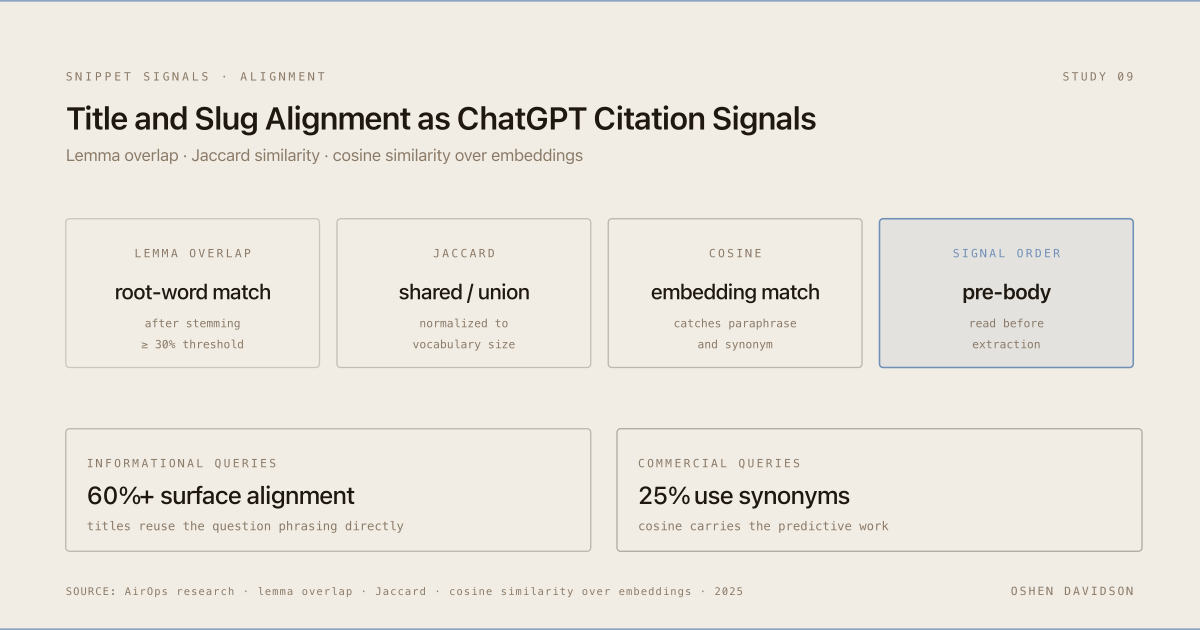
Page title and URL slug are the two snippet-level signals a search engine sees before the body content. They are also the two signals most directly tunable by a content team without redesigning the page.
This study measures how tightly each one aligns with the search language among pages ChatGPT actually cited, and how that alignment profile differs across commercial and informational query intents.
The pattern is consistent at the high end and diverges sharply at the boundaries.
Research question
Among pages ChatGPT cites, how closely do page title and URL slug align with the user’s search language, and does that alignment profile shift between commercial and informational queries?
Dataset
Pages from cited GPT-4.1 (ChatGPT, consumer interface) responses across commercial and informational queries. Each page paired with the original query that surfaced it, and analyzed for two attributes: page title and URL slug.
Three alignment measurements per pair:
| Method | What it measures | Output |
|---|---|---|
| Lemma overlap | Shared root words after stemming | Raw count |
| Jaccard similarity | Shared words / total unique words | Percentage |
| Cosine similarity | Semantic alignment via embeddings | 0.0 to 1.0 |
A page-attribute pair was treated as “aligned” if lemma overlap was 30% or more, or if cosine similarity exceeded a defined threshold.
Methodology
For each cited page, the page title and URL slug were extracted and tokenized. The original query was tokenized with the same procedure.
Three alignment scores were computed per page-attribute pair (title-vs-query and slug-vs-query):
- Lemma overlap. Count of shared root-form words after stemming, reported as a percentage of the query’s lemma set.
- Jaccard similarity. Shared lemmas divided by the union of lemmas in both strings.
- Cosine similarity. Computed over sentence embeddings of the two strings, capturing semantic relationships that surface-level overlap misses.
A page-attribute pair was classified as aligned when lemma overlap ≥ 30% of the query’s lemma set OR cosine similarity exceeded a calibrated threshold. Intent classification was rule-based, with queries split into commercial, informational, and mixed.
Alignment distributions among cited pages were measured separately by query intent and by alignment bucket. Significance testing: chi-square for distribution differences across alignment buckets, with Bonferroni correction across the intent-by-method comparisons.
Informational queries demand high surface alignment
For informational queries (questions, definitions, how-to phrasing), more than 60% of cited pages had titles or slugs that directly matched the search language.
Clear, direct phrasing carries the signal. Queries starting with “how to,” “what is,” “best practices,” and similar question-words map to titles that reuse the same construction. Pages that abstract or reframe the question miss the citation gate at higher rates.
The pattern aligns with how LLMs interpret query intent on simple factual queries. The model reads the title-slug pair as evidence the page is structured to answer the question directly.
Commercial queries tolerate vocabulary variation
For commercial queries (comparison, shortlist, product evaluation), 25% of cited pages used synonyms or paraphrases rather than direct keyword matches in the title or slug.
That tolerance is meaningful. On commercial queries, ChatGPT is willing to accept semantic alignment (cosine similarity) where surface-level overlap (lemma or Jaccard) is weaker.
The pattern is consistent with commercial pages being inherently more varied. A “HubSpot vs Salesforce” comparison page might be titled “CRM comparison,” “Salesforce alternatives,” or “Best CRM tools for B2B,” all of which are valid answers to the same buying question.
Discussion
Two patterns are worth surfacing.
Cosine similarity catches what lemma overlap misses. On commercial queries especially, semantic alignment carries more of the signal than vocabulary overlap. A page titled “Salesforce alternatives” with a query “best CRM tools” has near-zero lemma overlap but high cosine similarity, and pages like it show up in the cited set.
Snippet-level signals operate before body content. Title and slug alignment is read by the model before any extraction from the page body. Among cited pages, strong title-slug alignment is the dominant pattern; pages cited despite weak surface alignment are the minority and skew commercial, where semantic alignment substitutes.
Limitations
- Cited pages only. The dataset contains pages that earned citations. It describes the alignment profile of winners, not the citation rate of aligned vs. non-aligned pages; that comparison would require a retrieved-but-not-cited control set.
- ChatGPT-specific. Generalization to Claude, Perplexity, or other AI-search engines is not claimed.
- Title and slug only. The study isolates the two snippet-level signals and does not control for body-content alignment. The cited pages may have body alignment that compounds the title-slug effect.
- Intent classification. Queries were classified as commercial or informational based on phrasing. A subset of queries can be either depending on user context; the classification is a clustering variable.
- Three alignment methods may interact. Pages can score high on cosine similarity but low on lemma overlap, or vice versa. The “aligned” definition uses an OR threshold; alternative AND thresholds would tighten the criterion.
Related work
- Citation Selection in Commercial AI Search: A Stage-Based Analysis of Retrieved Pages: the buying-journey breakdown that contextualizes when title alignment matters most.
This research was first published as an AirOps report.